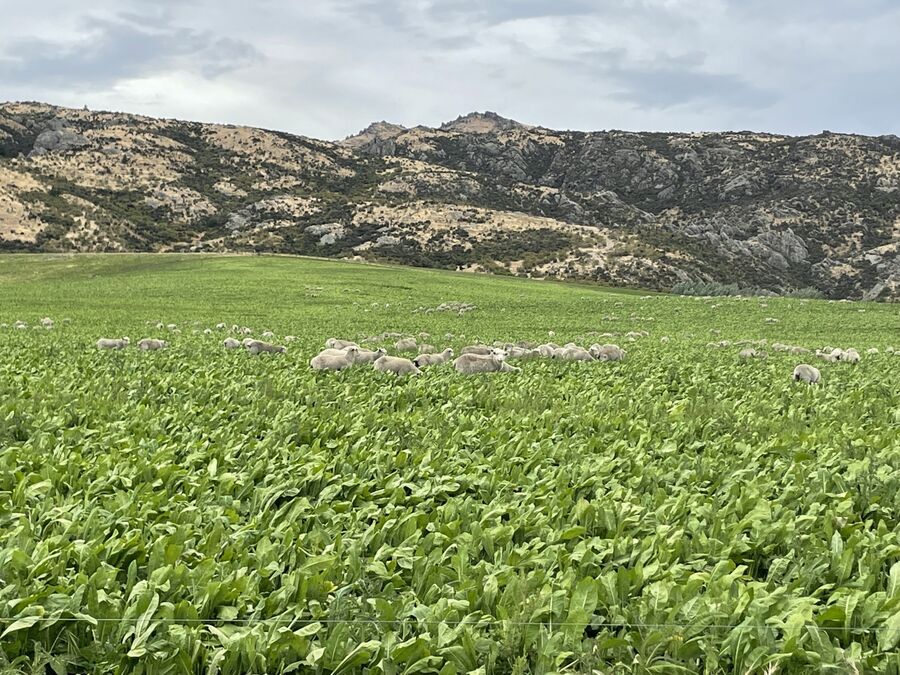
If you are planning summer feed for weaned lambs, now is the time to act. The aim is simple: have a bulk of quality feed standing in the paddock when summer conditions knock pasture growth back.
The forecast super El Niño has not fully shown its hand across most of the country yet, but it is still predicted to arrive. For much of Canterbury and Otago, that means hot nor’westers and soil moisture disappearing fast once it does. Southland and the western margins may see the opposite: more rain, more wind and more variability.
Right now, most of us still have good soil moisture. That is the opportunity - A summer forage crop turns spring moisture into a bulk of standing feed and carries it forward into summer, when pasture cannot deliver. While the moisture is there, it is a good time to get even a later-sown option in the ground.
The Numbers Stack Up
With the lamb schedule forecast looking promising, it has never been more profitable to add weight to lambs produced on farm.
Take a lamb gaining 250 g/day liveweight, which is roughly 125 g of carcass. On a $10/kg schedule, that’s $1.25 per head per day. Now say it is offered 2 kg DM/head/day of a forage that cost 10c/kg DM to grow - the feed costs 20c per head per day.
That is around $1.05/day of margin, better than a 6:1 return on the feed. Over a 60-day finishing period, it adds up to roughly $63 per lamb above feed cost. Even allowing for less-than-perfect utilisation, the sums are hard to argue with.
Cleaner Feed, Fewer Worms
Drench resistance is on the rise, and it is costing more farms than most realise. Non-grass crops are one of the best tools we have to take the pressure off.
Forage brassicas and herb–clover mixes are poor hosts for L3 larvae. A crop sown after cultivation also starts out with very low larval contamination. Lambs grazing these crops pick up far fewer worms than they would on ryegrass-based pasture. That means better animal performance, fewer drenches and less pressure on the drenches that still work.
It also means you are not wasting good feed on animals carrying a worm burden - that matters when every kilo of liveweight is worth this much.
Rape
Rape is one of the simplest options. It is cheap to establish, carries a large bulk of feed into summer, and stock perform strongly on it. It also gives you a handy shot at thistles and weeds.
The catch is timing - Rape needs 70–90 days to ripen, so as we move into November, a late sowing risk not being ready until pasture has already run out. Regrowth also relies on summer rain. Back it where you can get it in now or irrigate, and budget for a single grazing on dryland. Once stock are transitioned, keep them on it until lambs are prime.
Raphnobrassica
On dryland, this is likely the pick of the season. It does not need to ripen, so you can bring stock in as soon as pasture growth stalls, which makes it forgiving of a later sowing. It is drought hardy, with 38% greater water-use efficiency. Its clubroot tolerance makes it reliable under disease pressure, which matters in the wetter south too.
It can also roll into winter feed. That is valuable insurance if a dry autumn slows pasture recovery. The seed costs more than rape, but in a year where a failed crop costs you far more, that premium is cheap cover.
Leafy Turnips
Leafy turnips are the fast movers and the go-to for a later sowing. They establish quickly, can be grazed within 55–70 days and deliver excellent liveweight gains. There is no risk of rape scald, and they give another chance to get on top of weeds.
Their regrowth potential is only as good as the water behind them. Under the pivot they are hard to beat. On dryland, plan for a single graze. Hot, dry conditions can lift aphid numbers, and aphids spread mosaic virus, so monitor closely for that and for leaf miner.
Clover Finishing Swards
At this season’s lamb values, quality feed pays. Clover finishing swards deliver ME in the 13–14 range, five to six grazings across the season, and the flexibility to graze hard or lax. With good management they last two to four years.
Red clover and chicory do the heavy lifting in the dry thanks to their taproots, while white clover provides the base. Chicory improves carcass fatty acid profiles, and plantain helps reduce urinary nitrate. Because they’re a lower-worm feed than grass, they also take pressure off your drench programme.
On the flip side, seed costs are higher, and thistle control is trickier with herbs in the mix. Yields will slip if it gets properly dry. Red clover crowns sit above the soil, so the temptation to hammer the sward when feed gets tight is the biggest risk to it.
Kale
Kale is the long game, with a grazing window of 100–200 days - this year it is your insurance policy. If El Niño hangs on into autumn and pasture is slow to recover, a kale paddock carries stock through summer or rolls straight into the winter budget. It is cheap to establish, works for flushing ewes and offers a weed control window.
It needs good moisture at establishment, so it is a now-or-never call. Lambs do not utilise it as well later in the season, and the dense canopy can shade thistles, making them harder to control.
Lucerne
On lighter soils, this is the kind of season lucerne earns its keep. Its deep taproot makes it highly drought tolerant, and stands last five to eight years with good management. Quality is consistent, and it fixes its own nitrogen. Take a spring cut early to bank supplement ahead of the dry.
It still has its sensitivities. It will not tolerate wet feet or set stocking, it goes dormant over winter, and it needs annual winter spraying to stay clean. Despite best efforts, red gut remains an ongoing risk.
No single crop solves every problem, but the case for summer forage this season is as strong as it gets. You have good soil moisture now, a dry summer on the way, promising lamb prices and the growing need to keep lambs off wormy pasture. All of it points the same way.
- Raphnobrassica and lucerne bring dryland resilience.
- Leafy turnip is the best late-sown option.
- Rape suits early sowings and reliable water.
- Clover swards turn lamb values into kilos.
- Kale covers you if the dry runs into autumn.
The window will not stay open long. Give us a shout, and we will walk the paddocks with you, match the crop to the water, and build a summer feed plan that stacks up paddock-to-paddock - that’s Performance Agronomy™.