It's no secret that home-grown grass is the cheapest feed on farm. But as days shorten and soil temperatures drop, so does pasture production. One of the most cost-effective tools available to counter this is gibberellic acid (GA3) - a naturally occurring plant hormone that can provide a significant and measurable boost to dry matter production during these shoulder periods.
How Gibberellic Acid Works
GA3 stimulates plants to mobilise root reserves for leaf and stem expansion at a cellular level, effectively replacing the plant's requirement for long days and warm temperatures to trigger growth. When soil temperatures are above 13–14°C, plants produce sufficient GA3endogenously. However, as soils cool below this threshold, exogenous application of GA3 can compensate for this deficit and maintain growth momentum.
For best results, GA3 should be applied within 5 days of grazing when there is sufficient green leaf present for uptake. Under these conditions, dry matter responses of 200–500 kg DM/ha are typically observed within 3–4 weeks of application, with responses as high as 1,000 kg DM/ha recorded under optimal conditions.
Why Nitrogen Is Essential
When GA3 is applied alone, a yellowing effect can occur as chlorophyll is effectively diluted across a rapidly expanding leaf area. Co-application with liquid nitrogen addresses this directly by providing the building blocks required for rapid cell expansion and chlorophyll synthesis.
Liquid urea applied in this way delivers nitrogen to the plant in the ammonium form - the preferred nitrogen pathway for ryegrass-based pastures. Unlike nitrate, ammonium can be converted directly to amino acids without the additional energy cost associated with nitrate reduction, making it a highly efficient nitrogen source during periods of rapid growth.
Crucially, applying smaller, targeted amounts of liquid nitrogen that are taken up directly by the plant reduces the amount of nitrate accumulating in the soil profile ahead of the drainage period - an environmentally important consideration as farms face increasing scrutiny around nitrogen losses.
Strategic Use to Reduce Total N Input
The combination of GA3 and liquid urea represents a targeted, efficient approach to shoulder season feed management. By stimulating a significant dry matter response from a modest nitrogen input, this approach can help reduce total on-farm nitrogen usage while maintaining feed supply - a meaningful outcome for both farm system performance and environmental stewardship.
Current Programme & Pricing
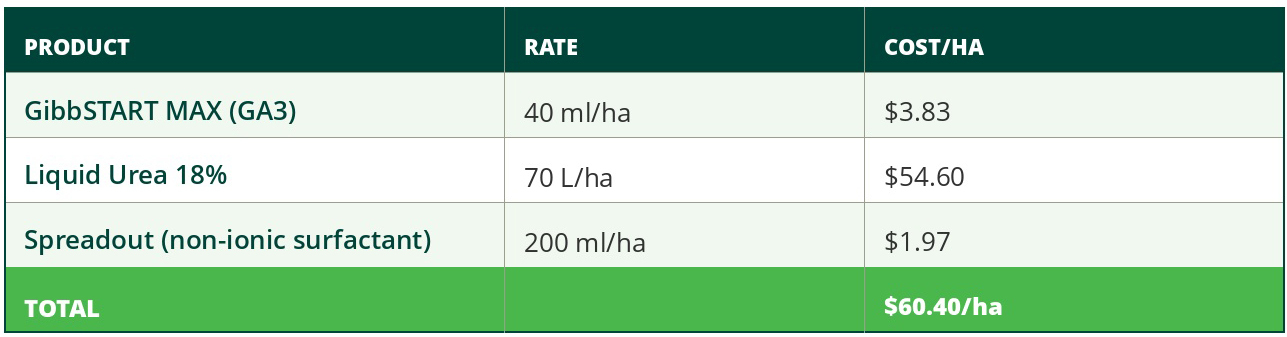
At a nominal response of 500 kg DM/ha, this equates to just 17c per kg DM grown.
Key Points
- Dry matter responses of 200–500 kg DM/ha are typical within 3–4 weeks of application when moisture and nitrogen are not limiting
- Apply in autumn, late winter or early spring when growth is limited by soil temperature
- Apply within 5 days of grazing when adequate green leaf is present for uptake
- Co-apply with liquid urea to prevent chlorophyll dilution and enhance dry matter response
- Liquid urea delivers nitrogen as ammonium - the most energy-efficient nitrogen form for plant uptake
- Targeted liquid nitrogen application reduces soil nitrate accumulation ahead of the drainage period